

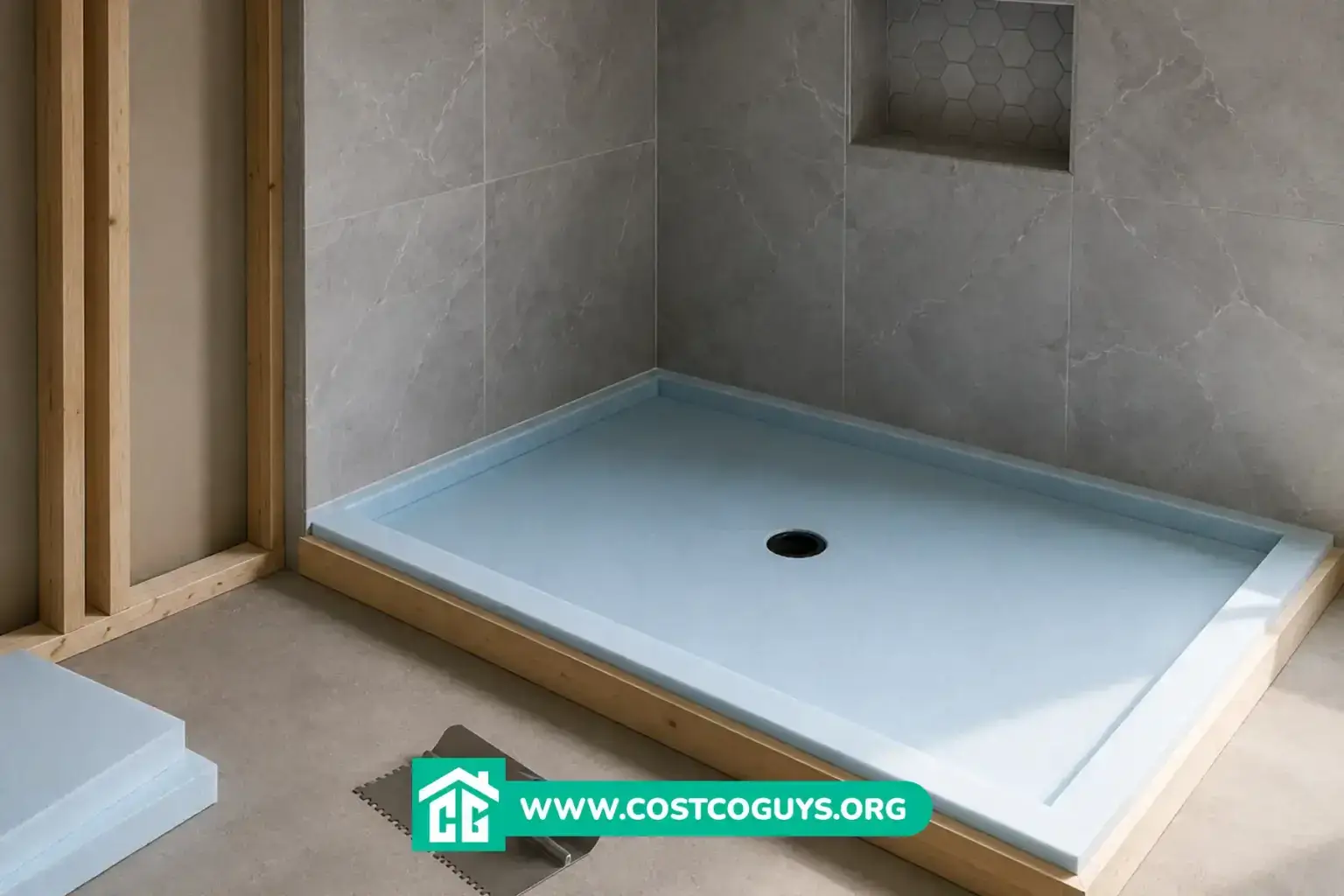

A custom foam shower pan is a pre-sloped, made-to-order shower base cut from rigid foam instead of hand-packed mortar. In 2026, pricing typically starts around $25 to $40 per square foot before drain, curb, and shipping costs.
- What Is a Custom Foam Shower Pan
- How Much a Custom Foam Shower Pan Costs in 2026
- Ordering a Custom Foam Shower Pan Step by Step
- Custom Foam Shower Pan vs Traditional Mortar Bed
- Choosing the Right Slope, Drain, and Curb
- Installing and Waterproofing a Foam Shower Pan
- Common Mistakes When Ordering a Custom Foam Shower Pan
- Getting a Custom Foam Shower Pan That Actually Fits
What Is a Custom Foam Shower Pan
A custom foam shower pan is built from high-density expanded polystyrene, or EPS. EPS is a rigid foam plastic that’s lightweight, resistant to moisture, and holds up well over time compared with other lightweight substrates. :antCitation[]{citations=”77f48490-d067-45a4-9cca-3960cba74a76″ injected=”space”} Manufacturers cut each pan to your exact shower dimensions and build the slope in at the factory, instead of you shaping wet mortar by hand on site.
Most custom foam pans ship ready to drop into place. You still add a waterproofing membrane and tile on top, the same as you would with a mortar bed. The foam just replaces the labor-heavy step of packing and screeding sand mud to a slope.
How Much a Custom Foam Shower Pan Costs in 2026
Pricing runs by the square foot, and it climbs with size, curb length, drain style, and shape complexity. One established foam pan manufacturer lists a starting rate of about $25.50 per square foot, with contractor pricing available for larger volumes. :antCitation[]{citations=”fb26e4ac-38a0-44e3-896d-36cb4ff07c49″ injected=”space”} A small rectangular shower, something like 32 by 60 inches, works out to roughly 13 square feet, so expect a base pan price somewhere in the low hundreds before extras.
| Item or Service | Typical Cost Range | What Affects the Price |
|---|---|---|
| Foam pan (per sq ft) | $25 to $40+ | Shape, curb, drain cutouts, order volume |
| Standard 32×60 shower pan | $350 to $700 | Straight edges vs curves, single vs neo-angle |
| Curb (if not built in) | Added per linear foot | Height, length, whether it’s molded into the pan |
| Bonding flange drain | $50 to $150 | Brand, tile-in vs linear style |
| Topical waterproofing kit | $75 to $200 | Square footage, membrane brand, seam tape needs |
| Shipping | Varies widely | Pan size, weight, distance from manufacturer |
What Shapes Custom Foam Shower Pan Pricing
Most manufacturers price custom foam pans in tiers, based on square footage and the labor needed to hand-fabricate large or oddly shaped pieces. Curbs, benches, and multiple drains add cost because each one takes extra cutting and shaping time. These ranges come from published pricing on foam shower pan manufacturer sites and should be treated as planning numbers, not a guaranteed quote for your specific project.
Ordering a Custom Foam Shower Pan Step by Step
Ordering a custom foam shower pan starts with accurate measurements, not a size chart. Here’s the general process most manufacturers follow.


- Measure your shower footprint at multiple points, since older framing is rarely perfectly square.
- Decide on drain location and type before you order, since the pan gets cut around it.
- Choose whether you want the curb built into the pan or added separately.
- Submit your measurements through the manufacturer’s order form, often with a simple sketch.
- Review your custom quote and confirm dimensions before production starts.
- Wait for fabrication and shipping. Some shops cut and ship same day, others take longer for complex shapes.
Double-check every measurement before you submit the order. Foam pans are custom made, so a mismeasured wall usually means a return trip through the order process, not a quick fix on site.
Custom Foam Shower Pan vs Traditional Mortar Bed
A traditional mortar bed shower pan uses layers of sand mud, hand-screeded to slope, with a rubber or PVC liner underneath. It’s proven, but it takes real skill to get the slope right and it adds significant weight to the floor.
A foam pan skips the mud entirely. The slope comes pre-built, and the pan itself weighs a fraction of a mortar bed. That makes it easier to carry into a bathroom alone and easier to set level over an uneven subfloor with shims.
The tradeoff is upfront cost per square foot, which often runs higher than raw mortar and sand. What you save is labor time and the risk of an inconsistent slope from hand-packing mud. For DIYers without mortar bed experience, that swap can be worth the price difference.
Choosing the Right Slope, Drain, and Curb
The International Plumbing Code requires shower floors to slope at least 1/4 inch per foot toward the drain, a standard echoed in the TCNA Handbook’s shower receptor methods. :antCitation[]{citations=”973bcdbf-38c1-4952-bc1b-16669b2115ae” injected=”space”} Most custom foam pans are pre-built to that same 1/4-inch-per-foot pitch, so the slope is already correct when the pan arrives. :antCitation[]{citations=”5bf7ff65-1f88-46f3-8073-a6f52c7e6e52″ injected=”space”} Local code offices can require different minimums in some cases, so confirm your slope and drain requirements with your local building department, also called the authority having jurisdiction, before you finalize your order.
Drain choice matters too. A bonding flange drain lets you tile straight over the pan without a separate clamping ring, which works well with most topical waterproofing systems. If you’re keeping an existing drain location, tell the manufacturer during ordering so the cutout lines up.
Installing and Waterproofing a Foam Shower Pan
Setting the pan is the easy part. Most installers dry-fit it first, check for level along the curb and walls, then bed it in thinset or adhesive recommended by the manufacturer. After that, you apply a topical waterproofing membrane, often a paint-on or sheet membrane like Kerdi, across the pan, curb, and up the walls.
Basic DIY skills cover measuring, dry-fitting, and applying surface waterproofing. Call a licensed plumber if the project involves relocating the drain line, cutting into existing waste plumbing, or if you find rot or damage in the subfloor once the old pan comes out. Permit rules for drain relocation vary by city, so check with your local building department before you cut anything.
Common Mistakes When Ordering a Custom Foam Shower Pan
The most expensive mistake is measuring an out-of-square shower like it’s a perfect rectangle. Walls settle over time, and a quarter-inch gap at one corner can throw off your curb and tile layout later.
Other frequent issues include ordering a pan without confirming drain compatibility, forgetting to specify the curb separately when it’s not molded in, and skipping a compatibility check between the foam pan and your chosen waterproofing membrane. A quick email to the manufacturer before ordering usually catches these problems early.
Internal link opportunity: link to a Costco Guys guide on waterproofing membranes for tile showers.
Internal link opportunity: link to a Costco Guys guide comparing shower base materials for a bathroom remodel.
Getting a Custom Foam Shower Pan That Actually Fits
A custom foam shower pan works best when your measurements are exact and your drain and curb choices are locked in before you order. Price depends mainly on square footage, curb length, and drain style, so get those details settled first and the rest of the project moves fast. If your bathroom has an unusual layout, an out-of-square footprint, or you’re unsure about local drain and slope rules, loop in a contractor or your local building department before you submit the order.
Are foam shower pans as durable as mortar bed pans?
High-density EPS foam pans hold up well under normal shower use once they’re properly waterproofed and tiled. Durability depends more on correct installation and waterproofing than on the base material itself.
Can I install a custom foam shower pan myself?
Yes, measuring, dry-fitting, and waterproofing a foam pan is within reach for a basic DIY skill level. Drain relocation or subfloor repair should go to a licensed plumber or contractor.
Do foam shower pans work with any drain?
Most are designed around a bonding flange drain, but manufacturers can cut the pan for other drain styles if you specify it during ordering. Confirm compatibility with the manufacturer before you submit your measurements.
How long does it take to get a custom foam shower pan?
Simple shapes ship quickly from some manufacturers, sometimes the same day the order is confirmed. Complex shapes, multiple drains, or built-in benches typically add production time.
Can a foam shower pan handle heavy tile or natural stone?
Manufacturers generally rate high-density foam pans for standard tile and stone loads used in residential showers. Check the specific product’s weight rating with the manufacturer if you’re planning a heavy natural stone install.
