

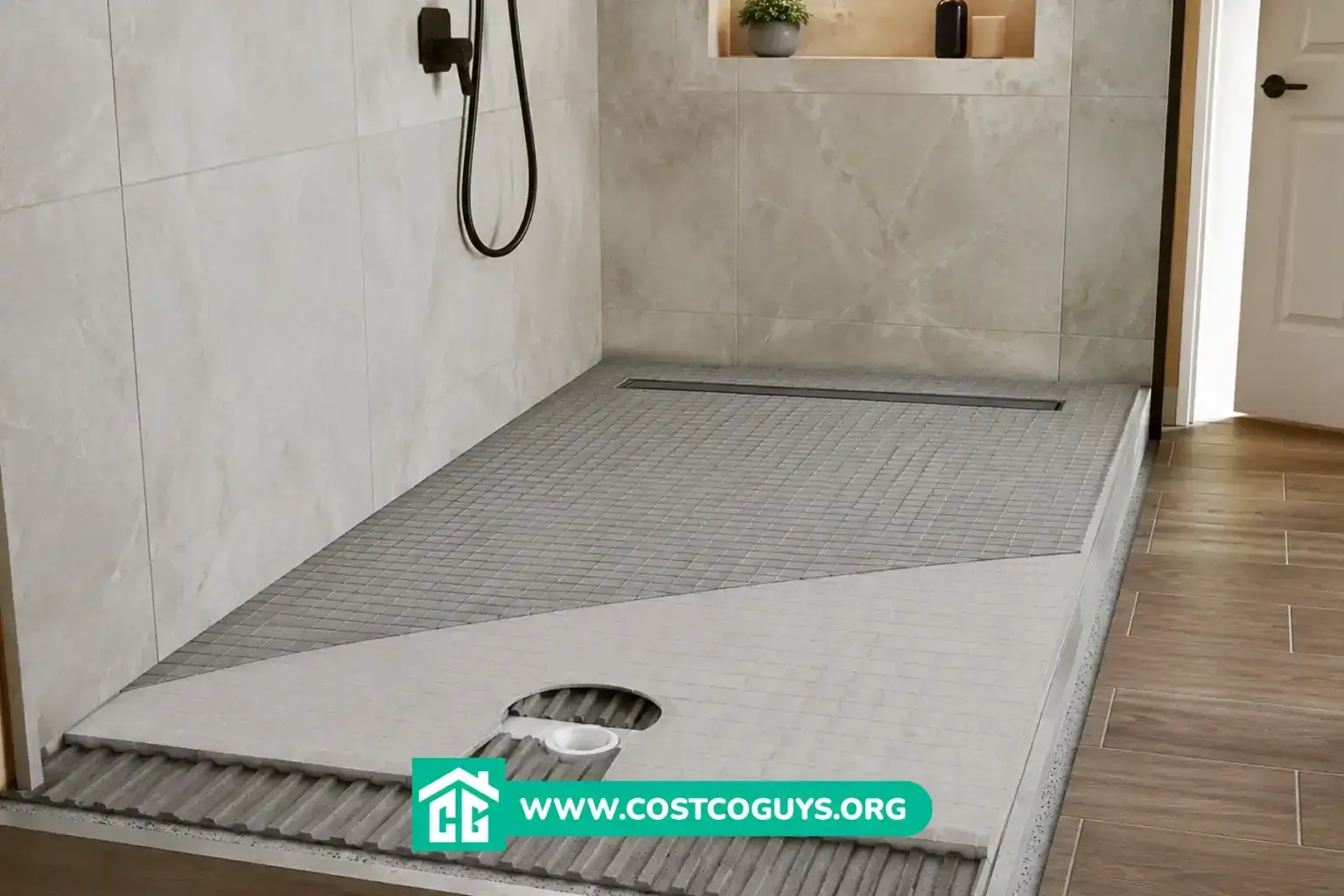

A Tile Redi curbless shower pan typically costs $700 to $900 for the pan itself. A fully installed price lands between $1,200 and $2,500 once labor is added. The final number depends on pan size and drain location. It also depends on whether you install it yourself or hire a tile contractor in 2026.
- What a Tile Redi Curbless Shower Pan Actually Is
- Tile Redi Curbless Shower Pan Sizes and Prices
- How the Flat Bottom Design Handles Drainage
- Step-by-Step: Installing a Tile Redi Curbless Shower Pan
- Tile Redi Curbless Shower Pan Cost Breakdown
- How We Reached These Cost Estimates
- Common Mistakes That Cause Leaks Later
- When to Call a Professional Instead of DIYing It
- Tile Redi Curbless Pan vs a Traditional Mud Bed Shower
- Is a Tile Redi Curbless Shower Pan Worth the Cost
- Tile Redi Curbless Shower Pan FAQs
What a Tile Redi Curbless Shower Pan Actually Is
A Tile Redi curbless shower pan is a one piece, ready to tile shower base. It has no raised curb at the entrance. Instead of stepping over a lip, you walk straight from the bathroom floor into the shower. The surface pitches toward a drain hidden under the tile. Tile Redi builds these pans from solid polyurethane. That means no mud bed, no membrane sheet, and no separate waterproofing step to get wrong.
Tile Redi calls this line “barrier free.” It covers the same category most people search for as zero threshold or curbless showers. You’ll also see similar flat bottom pans marketed under different drain styles: center drain, back drain, and linear trench drain. Each one skips the traditional curb. That makes the shower easier to enter for anyone using a wheelchair, walker, or cane.
The pan arrives ready for tile. The top surface is textured to grip thinset mortar the same way a concrete floor does. You don’t pour a mud bed or wait days for it to cure. You set the pan, plumb the drain, and tile directly on top once the pan is level and secured.
Tile Redi Curbless Shower Pan Sizes and Prices
Tile Redi sells barrier free pans in a wide range of sizes. Options run from compact 32 by 60 inch models up to large 42 by 72 inch bases. These bigger bases fit larger walk-in showers. Home Depot listings for Tile Redi curbless models in mid-2026 start around $690 for smaller sizes. Larger pans with premium drain grates run $900 or more.
Drain placement affects price too. Left, right, and center drain configurations cost about the same. A linear trench drain grate usually adds $50 to $150 over a standard round drain. If you’re matching an existing drain location from a tub-to-shower conversion, tell your contractor the exact spot before ordering. Tile Redi pans aren’t easy to modify after they’re made.
Base thickness matters for tight bathrooms. Most flat bottom pans measure under an inch thick at the thinnest point near the entrance. That thin edge makes a true curbless threshold possible. You don’t need to cut into the subfloor to get it. You can check exact dimensions for any model at www.tileredi.com before you order. Sizes and drain positions vary by product line.
How the Flat Bottom Design Handles Drainage
Every Tile Redi curbless shower pan comes pre-pitched at the factory. The slope usually runs about a quarter inch per foot toward the drain. That pitch is molded into the polyurethane, so you’re not trying to build a slope by hand with mortar. This is the biggest reason these pans work well for a DIY bathroom project. The hardest part of curbless shower design is getting the floor to drain correctly. Tile Redi solves that before the pan reaches your house.
Water that reaches the entrance still needs somewhere to go besides your bathroom floor. Most curbless installations handle this two ways. Some extend the pan’s pitch a few inches past the shower opening. Others rely on a linear drain at the threshold. It catches runoff before it crosses into the room. A frameless glass panel near the entry also helps contain splash. It does this without blocking the open feel that makes curbless showers popular.
Step-by-Step: Installing a Tile Redi Curbless Shower Pan
Tile Redi publishes a detailed installation video on YouTube that walks through the full process. It’s worth watching before you start, even if you’re hiring a pro. The basic sequence looks like this for most single curb and barrier free models.
- Confirm the subfloor is level and structurally sound. Dry fit the pan in the opening before you touch any plumbing.
- Rough in or adjust the drain so it lines up with the pan’s built-in drain location. This applies whether that’s center drain or offset.
- Set the pan in a bed of thinset mortar or the manufacturer’s recommended adhesive. Check it with a level in both directions.
- Connect and test the drain assembly for leaks before you cover any part of the pan with tile.
- Tile directly onto the pan’s textured surface using standard thinset, working from the drain outward.
The whole install, not counting tile work, usually takes a single day. That’s realistic for someone comfortable with basic plumbing and flooring tasks. Tile Redi also offers a step-by-step online course for DIYers. It covers more detail than a single instruction sheet or video can.
Tile Redi Curbless Shower Pan Cost Breakdown
The table below separates the pan cost from labor and related materials. Those numbers often get mixed together in online estimates.
| Item or Service | Typical Cost Range | What Affects the Price |
|---|---|---|
| Tile Redi curbless pan (pan only) | $700 – $900 | Pan size, drain style, left/right/center configuration |
| Professional installation labor | $500 – $1,200 | Curbless pans need extra time for precise leveling and drain alignment |
| Drain kit upgrade (linear or designer grate) | $50 – $150 | Standard round drains cost less than trench or designer grates |
| Tile and thinset for shower floor and walls | $400 – $1,800+ | Tile material, square footage, and pattern complexity |
| Glass panel or partial enclosure | $300 – $1,200 | Frameless glass costs more than framed panels |
A pan-only DIY install often lands close to $800 to $1,000 total. That’s if you handle the labor yourself and hire a plumber just to check the drain connection. A fully professional install, including a basic tile job, more commonly runs $2,000 to $4,000. Some projects involve relocating plumbing or cutting into a concrete slab to lower the drain. Expect the total to climb higher in that case. A full curbless bathroom renovation typically runs $6,000 to $15,000.
How We Reached These Cost Estimates
These figures come from comparing current Tile Redi listings on Home Depot’s site. I weighed that against labor pricing data from This Old House and Angi’s 2026 cost guides. Retail pan prices reflect what’s actually listed for barrier free models as of mid-2026, not a single averaged number. Labor ranges reflect national data for shower pan installation generally. I adjusted them upward for the extra leveling and drain work. Curbless pans need more of both than a standard curbed base.
Treat every number here as a typical range, not a guaranteed local price. Regional labor rates, permit requirements, and the condition of your existing subfloor all shift the final bill. A contractor’s written estimate for your specific bathroom will always be more accurate than any published range, including this one.
Common Mistakes That Cause Leaks Later
Skipping the drain test is the most common mistake installers make with any ready-to-tile pan. Running water through the drain before you tile catches leaks early. That’s easier than finding them after grout and tile are already down. Once tile covers a bad seal, finding the leak means tearing out finished work.
Another frequent problem is uneven thinset coverage under the pan itself. If the mortar bed under the pan has gaps or air pockets, the pan can flex slightly under weight over time. That flex stresses the seal at the drain. Back-butter the pan and use enough thinset to fill the full footprint, not just the edges.
Ignoring the transition zone at the entrance causes trouble too. There’s no curb to physically stop water here. The floor slope just outside the shower matters as much as the pan’s pitch inside it. Local building codes typically require a minimum slope in that transition area. Check your code requirements before finalizing the layout.
When to Call a Professional Instead of DIYing It
Hire a licensed plumber or tile contractor for bigger changes. That includes moving the drain location or cutting into a concrete slab. It also covers cast iron plumbing that needs modification. These changes affect your home’s plumbing system and often require a permit. A mistake here costs far more to fix than it would have cost to hire out.
DIY installation makes more sense in a simpler scenario. That’s replacing an existing shower pan in the same footprint and drain location. It also helps if you already have basic tile and plumbing experience. In that scenario, the pan’s pre-pitched design removes most of the guesswork that used to require a professional tile setter.
Tile Redi Curbless Pan vs a Traditional Mud Bed Shower
A traditional mud bed shower floor is built by hand from mortar, sloped and waterproofed on site before tile goes down. It gives a contractor full control over custom shapes. But it takes several days to cure. It also depends heavily on the installer’s skill to avoid low spots where water pools.
A Tile Redi curbless pan skips that entire process. The pitch and waterproofing come built into the one piece base at the factory. You give up some custom shaping flexibility, but you gain a leakproof, factory-tested surface and a much shorter installation timeline. For most standard bathroom sizes, a flat bottom pan like this is faster and more predictable. That’s why it’s become common in bathroom remodeling projects that need to stay on schedule.
If you’re comparing retailers, Tile Redi sells directly and through outlets like Home Depot and Freedom Showers. Both carry similar barrier free pans alongside the Tile Redi lineup. Pricing across these sellers stays close. Shop based on shipping cost and current stock rather than expecting a big discount at any one source.
Is a Tile Redi Curbless Shower Pan Worth the Cost
Most homeowners plan a bathroom renovation with accessibility or resale value in mind. A Tile Redi curbless shower pan earns its price two ways. It cuts installation time. It also removes the biggest risk factor in a curbless build: getting the slope wrong. Budget $700 to $900 for the pan. A professional install of the pan alone runs $1,200 to $2,500. Total project costs climb higher once tile, glass, and any plumbing changes enter the picture. The pre-pitched, ready-to-tile design is what separates this product from a standard curbless shower pan. It’s the reason so many tile contractors reach for it on barrier free jobs.
Tile Redi Curbless Shower Pan FAQs
Can you install a Tile Redi curbless shower pan yourself?
Yes, if you’re replacing a pan in the same footprint with the same drain location. The pre-pitched, ready-to-tile surface removes the hardest part of a DIY curbless install. Still, have a licensed plumber check the drain connection before you tile over it.
How much does a Tile Redi curbless shower pan cost installed?
Expect to pay $1,200 to $2,500 for the pan plus professional installation labor, not including tile or glass. Add tile, thinset, and a shower enclosure and the total project often reaches $2,000 to $4,000.
Do curbless shower pans need a special drain?
Not necessarily. Tile Redi curbless pans work with standard round drains or upgraded linear trench drains. Both integrate with the pan’s built-in pitch. A linear drain typically adds $50 to $150 over a basic round drain.
Are Tile Redi shower pans actually leakproof?
The one piece polyurethane construction has no seams where water can get through. That’s what makes these pans leakproof when installed correctly. Most failures trace back to installation errors, like skipping the pre-tile drain test, rather than a flaw in the pan itself.
What’s the difference between a curbless pan and a barrier free pan?
They describe the same product. Tile Redi markets its zero threshold line as “barrier free.” Curbless is the more common consumer search term for the same flat, no-curb entry design.
