

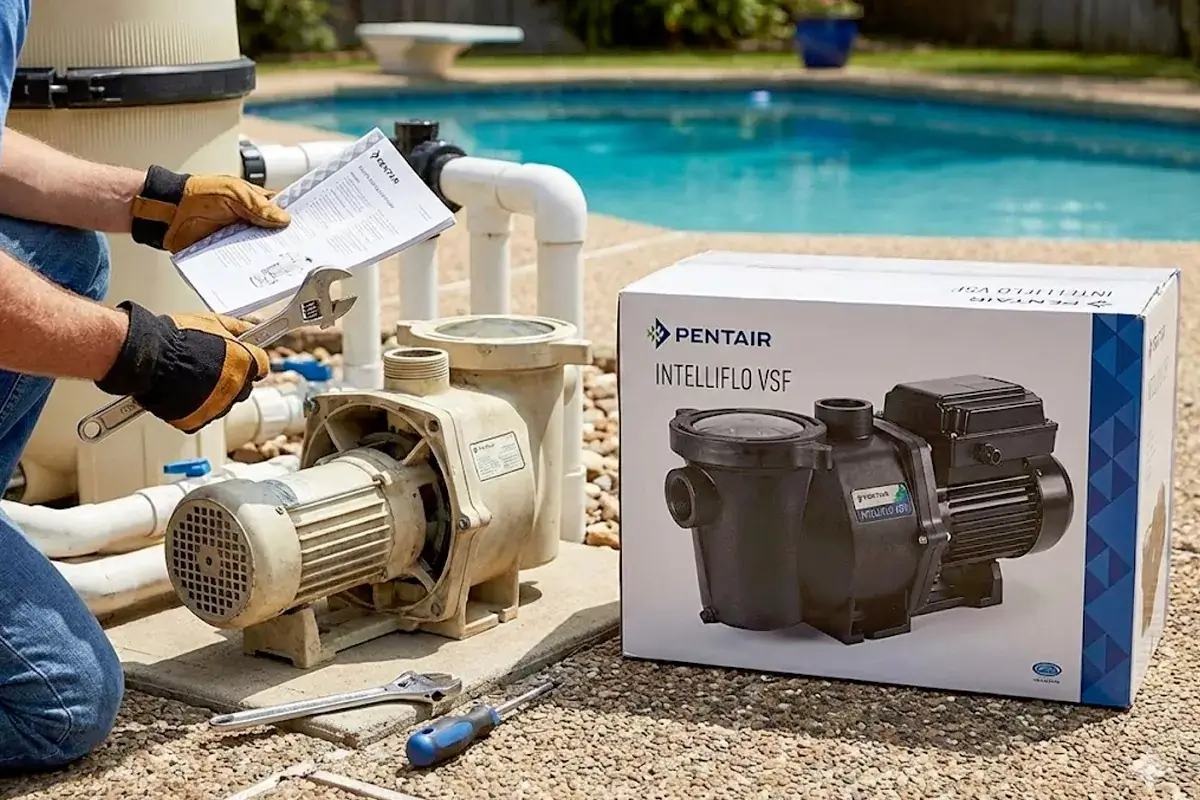

Pentair pool pump replacement becomes necessary when your pump shows signs of wear after 8 to 12 years of service. You need a new pump when you hear grinding noises, see water leaks, notice weak circulation, or watch your energy bills climb. This pool equipment upgrade walks you through choosing the right model, installing it safely, and maintaining it for years of reliable service.
- Signs You Need a Pentair Pool Pump Replacement
- Repair vs Replace: Making the Right Choice
- Choosing the Right Pentair Replacement Pump
- What Pentair Pool Pump Replacement Costs in 2025
- New 2025 Regulations Affecting Pump Replacement
- Installing Your New Pentair Pump
- Energy Savings with Variable Speed Pumps
- Maintenance Tips to Extend Pump Life
Signs You Need a Pentair Pool Pump Replacement
Your pump tells you when it needs replacement through clear warning signs.
Strange sounds from your pump mean trouble. Grinding, screeching, or rumbling noises point to worn bearings or motor problems. A healthy pump runs with a quiet hum. Anything louder signals mechanical failure. Water leaks around the pump create puddles near your equipment pad or air bubbles shooting into your pool. Tightening connections might help temporarily, but persistent leaks mean the seals have failed. Weak water flow takes longer to clear debris from your pool. If your pump needs more than 8 to 10 hours to filter your pool water, its efficiency has dropped.
Your pump might overheat and shut down repeatedly. A pump should never get too hot to touch with your bare hands. High temperatures indicate the motor struggles under load. Rising electricity bills signal inefficiency. An old standard pump uses 1,500 to 2,500 watts compared to just 300 watts for a modern variable-speed pump. Pool water that turns cloudy quickly despite regular shocking means your pool filtration system can’t keep up anymore. These symptoms of failing equipment require prompt attention to avoid complete system breakdown.
Repair vs Replace: Making the Right Choice
Deciding between repair and complete pump replacement depends on your pump’s age and repair history.
A well-maintained pool pump typically lasts between 8 to 12 years. Simple fixes make sense for newer pumps under five years old. Replacing small parts like seals or bearings costs $65 to $200. But motor replacement costs $65 to $650 for parts and labor. If your pump exceeds 10 years or needs repeated repairs, a pump changeover to a new unit saves money long term. Cracked housing, rust, or corroded parts mean the pump reached the end of its useful life.



Variable-speed pumps tend to last longer, often between 10 and 15 years, due to their optimized speed settings and reduced wear. Older single-speed models wear out faster. Magnetic drive motors in variable-speed pumps turn with no friction, using less energy and lasting longer than old copper winding motors. Calculate the cost of repairs against a new pump. If repairs exceed 50% of replacement cost, buy new. You also gain modern features like energy-efficient operation, quieter performance, and IoT-compatible automation. This pool system maintenance decision impacts both immediate costs and long-term operating expenses.
Choosing the Right Pentair Replacement Pump
Selecting the correct pump model requires matching your pool’s specific needs. This pump installation choice affects performance for years.
Start with your pool size and flow rate requirements. Your pump should filter all pool water in 8 to 12 hours. A standard pool holds about 25,000 gallons according to the US Department of Energy. Calculate your required gallons per minute by dividing pool volume by the desired turnover time. Pentair offers several current models for your IntelliFlo replacement or SuperFlo upgrade. The IntelliFlo3 VSF pump features proprietary flow technology that maintains optimal flow while adjusting to pool conditions, helping owners save up to 90% in energy consumption. It offers WiFi-enabled automation that unlocks the ability to connect two additional pool products for streamlined pool management. The SuperFlo VST includes RS-485 connectivity for improved interface with automation systems and IoT devices.
Starting September 2025, Pentair’s IntelliFlo3 VSF Pool Pump and IntelliCenter Pool Control System support Flexible Demand capabilities, allowing pool equipment to respond to energy grid demand signals during peak hours. This smart-enabled technology helps reduce energy costs while supporting grid stability. Check your existing plumbing before ordering. Measure pipe diameter at connection points. Most residential pools use 1.5 or 2-inch PVC plumbing. Verify electrical requirements. The SuperFlo VST can adapt to 115V to 230V and 50hz or 60hz power with no special wiring or switching. Confirm physical space on your equipment pad. Measure clearance around your current pump. New pumps need proper ventilation and access for maintenance. Match horsepower to your pool’s needs. Small to average pools work well with 1.5 HP pumps. Larger pools or those with water features need 2 to 3 HP models.
What Pentair Pool Pump Replacement Costs in 2025
Understanding replacement costs helps you budget for this essential circulation system overhaul.
A standard pool pump replacement costs an average of $1,300, with a range of $160 to $6,000. The pump itself typically costs between $200 and $1,200, depending on specifications. Professional installation fees range from $100 to $400, covering the removal of the old pump and installation of the new one. Pentair pumps sit at the premium end. Premium brands like Pentair may cost up to $1,600. Variable-speed models cost more upfront but save significantly on electricity. Variable-speed pool pumps can range between $2,000 to $3,000 including tax, plumbing and electrical requirements when installed by a licensed pool contractor.
Additional costs might apply for special situations. Hiring an electrician costs $40 to $100 per hour for electrical wiring modifications. A plumber costs $45 to $150 per hour to replace pipes and connectors. You might need union fittings for easy future maintenance. Local labor rates vary by region. In Southern California, homeowners report quotes of $2,300 for a Pentair SuperFlo 2.0 HP Variable Speed Pump including materials and labor. Get multiple quotes from licensed pool professionals. Compare total project cost, not just equipment price. Original Equipment Manufacturer variable-speed pool pumps such as Jandy, Pentair, and Hayward offer 3-year manufacturer warranties when purchased from authorized dealers. This warranty-backed protection provides peace of mind for your investment.
New 2025 Regulations Affecting Pump Replacement
Recent Department of Energy standards change what pumps you can install.
Compliance with new standards for dedicated purpose pool pump motors with motor total horsepower under 0.5 THP is required on and after September 29, 2025. For motors with 1.15 THP or greater, compliance is also required starting September 29, 2025. This tiered DOE motor regulation goes into effect in September 2025, with the second tier in 2027. These standards essentially require variable-speed motors for most replacements. Supplies of non-compliant, low-efficiency pumps will dwindle and disappear.
Pentair Pool announced in September 2025 that it added Flexible Demand capabilities to its pool automation equipment. California developed flexible demand appliance standards requiring pool controls to respond to price signals, prioritizing operation during hours when electricity prices are low and renewable generation is high. This grid-responsive technology represents the next generation of pool equipment. When you plan your equipment swap-out, ensure your new pump meets current DOE standards. Working with a licensed professional guarantees compliance with both federal and state regulations.
Installing Your New Pentair Pump
Professional installation ensures safety and optimal performance, but informed DIYers can handle this project.
Turn off all power at the circuit breaker before starting. Test the pump to confirm power is off. Never work on pool equipment with live electricity. Remove the old pump by disconnecting unions or cutting pipes if necessary. Drain remaining water from the pump housing. Save unions and quality fittings for reuse. Clean the equipment pad and check for level. An unlevel pump causes vibration and premature wear.
Electrical and Plumbing Prep
Position your new pump on the pad. Align it with existing plumbing connections. Use union fittings at both inlet and outlet. These allow easy removal for future maintenance. Apply Teflon tape to threaded connections. Hand-tighten unions, then add one-quarter turn with a wrench. Avoid over-tightening plastic fittings. Connect electrical wiring according to manufacturer specifications. Match wire colors correctly. Ground the pump properly using a solid copper wire to your pool’s bonding system. Electrical grounding and proper wiring prevent safety hazards.
Priming Your New Pump
Fill the pump basket completely with water before starting. This prevents dry running that damages the motor seal. Close all drain plugs securely. Open the inlet valve fully. Turn power on at the breaker. Watch for water flow through the clear pump lid. Air bubbles should clear within a few minutes. If the pump doesn’t prime after five minutes, turn it off and check for air leaks. Tighten the lid, check O-rings, and verify all connections. Once primed, monitor the pump for 30 minutes. Check for leaks, unusual sounds, or vibration.
Energy Savings with Variable Speed Pumps
Upgrading to a variable-speed Pentair pump delivers substantial long-term savings with your pool upgrade.
A variable-speed pool pump could save you up to 90% on your energy costs compared to a conventional single or two-speed pool pump. Here’s why the savings are so significant. A single-speed pump with a flow rate of 66 gallons per minute uses 2,000 watts per hour and consumes 12.6 kWh daily to turn over a 25,000-gallon pool. A variable-speed pump set at 22 gpm consumes only 116 watts per hour and uses just 2.2 kWh to turn over the same pool, even though it runs longer. That’s a savings of 10.4 kWh per day.
In California where average residential electricity rates reach 34.26 cents per kWh as of April 2024, you could save $1,300 annually with a variable-speed pump. The US Environmental Protection Agency estimates a conventional single-speed pump costs $400 to $500 annually to run, while an ENERGY STAR-rated variable-speed pump costs just $100 to $150. Variable-speed pumps consume less power and typically pay for themselves in 2 years or less. Many utilities offer rebates. Some areas provide a $350 rebate on ENERGY STAR certified variable-speed pool pumps. For the tenth year in a row, Pentair has been named ENERGY STAR Partner of the Year. This recognition confirms Pentair’s leadership in energy efficiency.
Maintenance Tips to Extend Pump Life
Regular care keeps your new Pentair pump running efficiently for years after this pump swap.
Clean the strainer basket weekly during swim season. A clogged basket makes your pump work harder, putting strain on the motor and reducing efficiency. Empty baskets more often if your pool collects lots of leaves or seeds, and clean immediately after storms or heavy rain. Check and lubricate O-rings monthly. Use silicone or Teflon-based lubricants on all O-rings and gaskets. Never use petroleum jelly as it breaks down rubber parts.
Inspect for leaks under the motor regularly. Seal failure can cause premature bearing failure if not identified early. Use a flashlight to look beneath the pump where the motor mates with the wet end to spot small leaks. Keep the pump ventilated. Heat is the biggest reason why variable-speed pumps fail early. Ensure adequate airflow around the motor. Program your variable-speed pump efficiently. Run it at lower speeds for longer periods instead of high speed for short times. This reduces wear while maintaining proper water circulation. Schedule annual professional inspections to catch problems early. Your Hayward replacement or Pentair will deliver the same maintenance benefits when properly cared for.
Your Pentair pool pump replacement delivers clean water, lower energy bills, and years of reliable service when you choose the right model and maintain it properly. Modern pumps with smart-enabled features and grid connectivity represent a significant advance over older technology, combining superior performance with environmental responsibility.
