

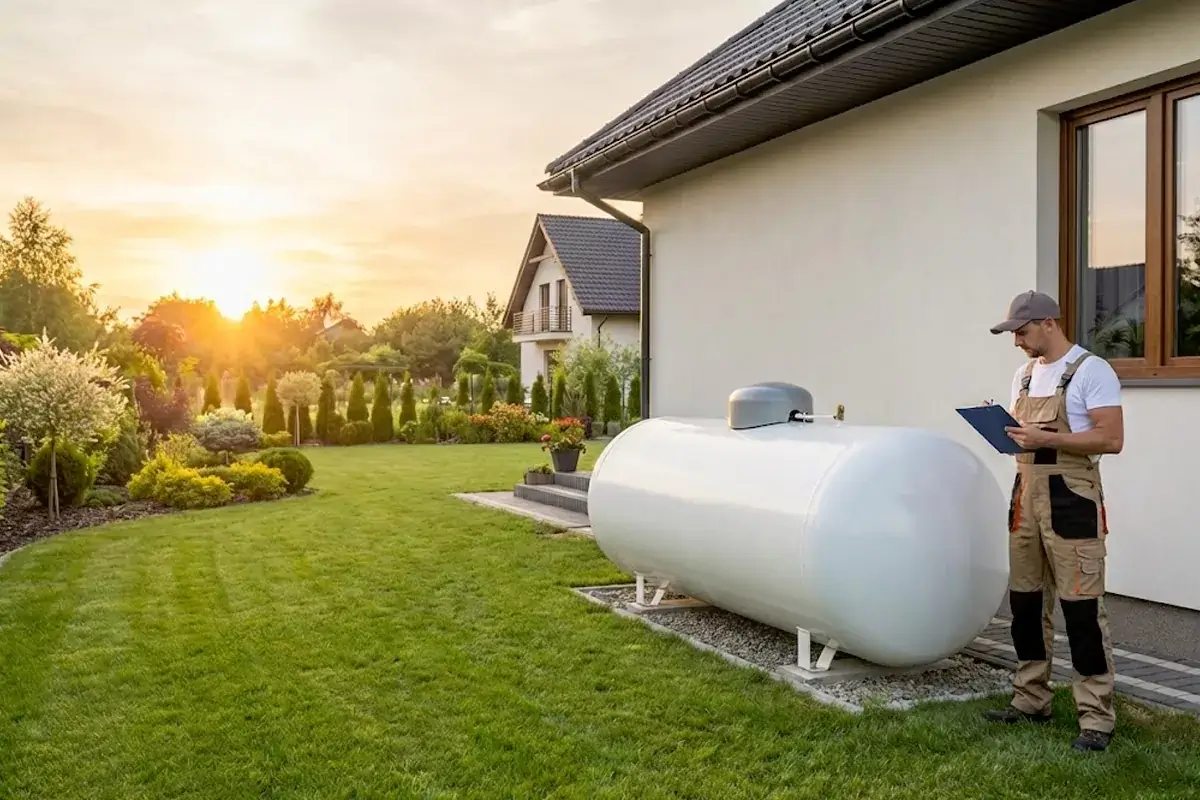

Installing a home propane tank costs most homeowners between $600 and $2,500, with the typical price landing around $1,400. The final amount depends on tank capacity, whether you choose above-ground or underground placement, and your location. Smaller 100-gallon tanks start near $600, while larger 1,000-gallon underground systems can reach $5,000 or more.
This guide breaks down what you’ll actually pay for residential propane storage, covers hidden expenses contractors don’t always mention up front, and helps you decide between buying and leasing. You’ll also learn about the ongoing maintenance costs that can catch new propane owners off guard.
How Much Does Tank Size and Placement Affect Cost?
Tank size (measured in gallon capacity) has the biggest effect on your final price, with a 250-gallon tank running $500 to $1,000 and a 1,000-gallon tank costing up to $3,500 just for the unit. Where you put it matters just as much.
Above-ground installations cost between $400 and $3,500, while underground setups range from $1,500 to $5,500. That’s because underground tanks need excavation work, which means hiring equipment and operators. Most families with standard 2,000-square-foot homes choose 500-gallon tanks since they hold enough fuel for heating, cooking, water heaters, and dryers without needing constant refills. These tanks stretch about 10 feet long with a 3.5-foot diameter, so you’ll need decent yard space if placing above ground.
Here’s what different sizes actually support. A 100-gallon tank handles one or two appliances like a stove or water heater. A 250-gallon tank works for smaller homes or limited heating needs. A 500-gallon tank powers most single-family homes completely. A 1,000-gallon tank fits larger properties or homes with pools and multiple heating zones.
Underground tanks look cleaner and protect fuel from temperature swings. They’re the better pick if you live somewhere with harsh winters or if you can’t stand looking at a big metal cylinder in your yard. Above-ground tanks cost less initially and make it easier to spot problems early, but they sit out in the open where weather and accidents can damage them. Both types represent different installation methods with distinct advantages.



What Are the Extra Costs Beyond the Tank?
The sticker price never tells the whole story. Plan for several add-ons that push your total up—these are part of the complete setup expense.
Concrete pads for above-ground tanks start at $50 for small units, while a 500-gallon tank needs a pad costing $125 to $175 that meets local codes. Gas line installation adds $250 to $800, depending on the distance from your tank to your house. The farther your tank sits from your home, the more piping you’ll need. Most codes require tanks to sit at least 10 feet from buildings.
Permits range from $25 to $150 based on your location and tank size. Some areas also require fire inspection fees on top of basic permits. If you’re replacing an old tank, removal costs about $100 for above-ground units and up to $1,500 for buried ones. That includes digging up the old tank, disposing of it properly, and filling the hole.
For underground installations, excavation runs $50 to $200 per cubic yard, with most 500-gallon tanks requiring 10 to 12 cubic yards. That brings excavation alone to $500 to $2,400 before you even set the tank in place. Some properties need land clearing or special equipment rentals, which can add another $200 to $500.
Don’t try handling installation yourself unless you’re putting in a tiny grill tank. The risks aren’t worth the savings, and most areas won’t let you do it without proper licensing anyway. Professional installation (the opposite of DIY work) ensures safety and compliance.
Ongoing Costs After Installation
The spending doesn’t stop once the tank’s in the ground. You’ll face regular expenses that add up over the years—these represent your total cost of ownership.
Fuel refills represent your biggest recurring cost. Propane runs about $2.59 per gallon in early 2025, though prices swing quite a bit depending on where you live and the season. Regional differences are significant, with prices ranging from $1.61 in Oklahoma to over $5 in remote parts of Maine. At current rates, filling a 500-gallon tank costs roughly $1,300. Tanks only get filled to 80% capacity for safety reasons, so that 500-gallon tank actually holds 400 gallons. Prices jump during winter when everyone needs heating fuel and drop in summer when demand falls off.
Annual safety checks run $50 to $75, with inspectors testing valves, checking for leaks, and verifying regulators work correctly. These checks aren’t optional if you want to keep your insurance coverage and stay legal. Underground tanks need extra attention since you can’t see problems forming.
Above-ground tanks need recertification every five years after the initial 12-year period, while underground tanks last 20 to 30 years before needing replacement. Recertification costs between $30 and $60 for most residential tanks. Skip recertification and companies won’t refill your tank. This periodic testing confirms your tank meets current safety standards.
Watch for rust patches near seams, dents or scrapes that weaken walls, propane smell near fittings, or outdated safety features. Any of these signs mean you need professional inspection right away. Think of tank maintenance as protecting your investment, not just an annoying chore.
How to Get an Accurate Local Estimate
National averages only get you so far. Actual costs in your area might run 30% higher or lower depending on local labor rates and regulations.
Call at least three licensed contractors and ask specific questions. How far does the tank need to sit from your house and property lines? What’s included in their quote—just the tank, or also the pad, gas lines, and permits? Do they handle permit applications or is that on you? How long have they been installing tanks, and can they provide recent customer references?
Distance from your house, soil conditions like rocky or sandy ground, and local regulations all influence the final cost. Rocky soil costs more to dig through. High water tables mean you can’t put tanks underground safely. Some neighborhoods have homeowner association rules about tank placement.
Get written quotes that break down every charge separately. Labor, materials, permits, concrete work, excavation, gas lines—you want each item listed with its own price. That makes it easy to spot if one contractor’s charging way more for labor or if another’s skimping on required safety features.
Check that contractors carry proper licensing and insurance. Ask about warranty coverage on both the tank and the installation work. Most reputable installers guarantee their work for at least a year. This protects you from installation defects and faulty workmanship.
Pros and Cons: Owning vs Leasing a Propane Tank
You don’t have to buy your tank outright. Many propane companies offer leasing arrangements (also called rental agreements) that change the math considerably.
Owning means higher upfront costs but more flexibility long-term. You can shop around for the cheapest propane supplier each time you need a refill. You’re not locked into one company’s prices. But you’re also responsible for all maintenance, repairs, and eventual replacement. A freestanding tank lasts at least 12 years after manufacture with proper care, then needs recertification every five years.
Leasing typically costs nothing upfront or requires minimal fees. Rental runs $50 to $200 per year depending on tank size, location, and supplier. The leasing company handles installation, maintenance, and repairs. You call them when something breaks and they fix it at no charge. But you’re stuck buying propane from that one company, often at higher rates than you’d find elsewhere. They also require minimum annual usage—usually several hundred gallons—or they charge penalty fees.
Do the math over five or ten years. If you use propane heavily and plan to stay in your home long-term, buying usually saves money. If you’re not sure how much you’ll use or might move soon, leasing makes more sense. Some companies even offer lease-to-own programs where your rental payments eventually add up to ownership.
The choice depends on how much propane consumption your home requires annually, how long you plan to live there, and whether you want to deal with maintenance yourself or pay someone else to handle it. Consider your heating needs, appliance count, and local climate when making this decision.
Key Points to Remember
Installing a propane tank isn’t just about buying the unit and sticking it in your yard. Smart homeowners plan for the complete picture—what industry experts call the full project cost.
Budget for the full installation package, not just the tank price. That means factoring in concrete slabs, gas lines, permits, excavation for underground tanks, and professional labor. Cutting corners on installation can lead to safety issues and failed inspections that cost more to fix later.
Calculate ongoing expenses before committing. Add up annual inspections, periodic refills based on your usage, and eventual recertification or replacement costs. A tank that seems affordable initially might drain your budget over time if propane pricing in your area runs high or if you need frequent refills.
Get multiple local quotes since costs vary widely by region. Labor rates, permit fees, soil conditions, and local regulations all affect your bottom line. What costs $1,200 in one state might run $2,000 in another for the exact same setup. Understanding regional price variation helps you budget accurately.
Consider your long-term plans when choosing between above-ground and underground, or between buying and leasing. Above-ground costs less now but might bother you aesthetically for decades. Leasing saves money upfront but locks you into one supplier. Think five to ten years ahead, not just about tomorrow.
Don’t skip maintenance trying to save money. Regular inspections catch small problems before they become expensive emergencies or safety hazards. That $75 annual inspection protects your $2,000 investment and keeps your family safe. Proper tank upkeep extends the lifespan of your equipment significantly.
Most importantly, hire licensed professionals for installation. This isn’t a DIY project unless you’re only hooking up a tiny grill tank. Propane’s safe when handled correctly but dangerous when installed wrong. Proper installation protects your home, keeps insurance valid, and ensures you pass inspections without costly do-overs. The safety benefits of professional work far outweigh any perceived savings from doing it yourself.
